

Your home’s equity is not the same as the amount you can borrow against it. In Australia, a common starting point is to calculate lending up to 80% of the property’s value, then subtract the current loan balance. For example, a home valued at A$750,000 with A$400,000 owing has about A$200,000 in usable equity on that basis. Using equity to buy an investment property can help fund a deposit and purchase costs, but it doesn’t determine how much you’ll be approved to borrow.
That distinction matters: lenders also assess your income, expenses, existing commitments, credit history and ability to manage repayments on the additional debt. The investment property’s price, expected rental income and loan structure can also affect the assessment.
This article explains how usable equity is calculated, why a property-value lending limit is only part of the picture, and what can affect your borrowing capacity. It also covers potential benefits and risks, including higher repayments and using your home as security, so you can assess whether the numbers suit your investment plans.
Key Takeaways
- Separate total equity from usable equity to get a more realistic view of the funds available for an investment deposit and purchase costs.
- Factor repayments, interest-rate changes and existing commitments into your cash-flow assessment before taking on additional debt.
- Keep backup funds available and consider how linking your home to investment borrowing could affect both properties if circumstances change.
- Compare a loan top-up, refinancing and a separate loan account, as each structure can affect how the borrowing is managed.
- Assess the lender’s property valuation and LVR limits alongside your income and expenses, rather than relying on equity alone to estimate borrowing capacity.
How does using equity to invest in property work?
Equity can contribute to an investment deposit and purchase costs, but usable equity is only one part of the borrowing assessment. A lender also considers whether your income and cash flow can support the additional loan.
Calculating home and usable equity
Home equity is your property’s current value minus the outstanding home loan balance. Lenders use the property value and existing debt to assess how much equity may be available to borrow against.
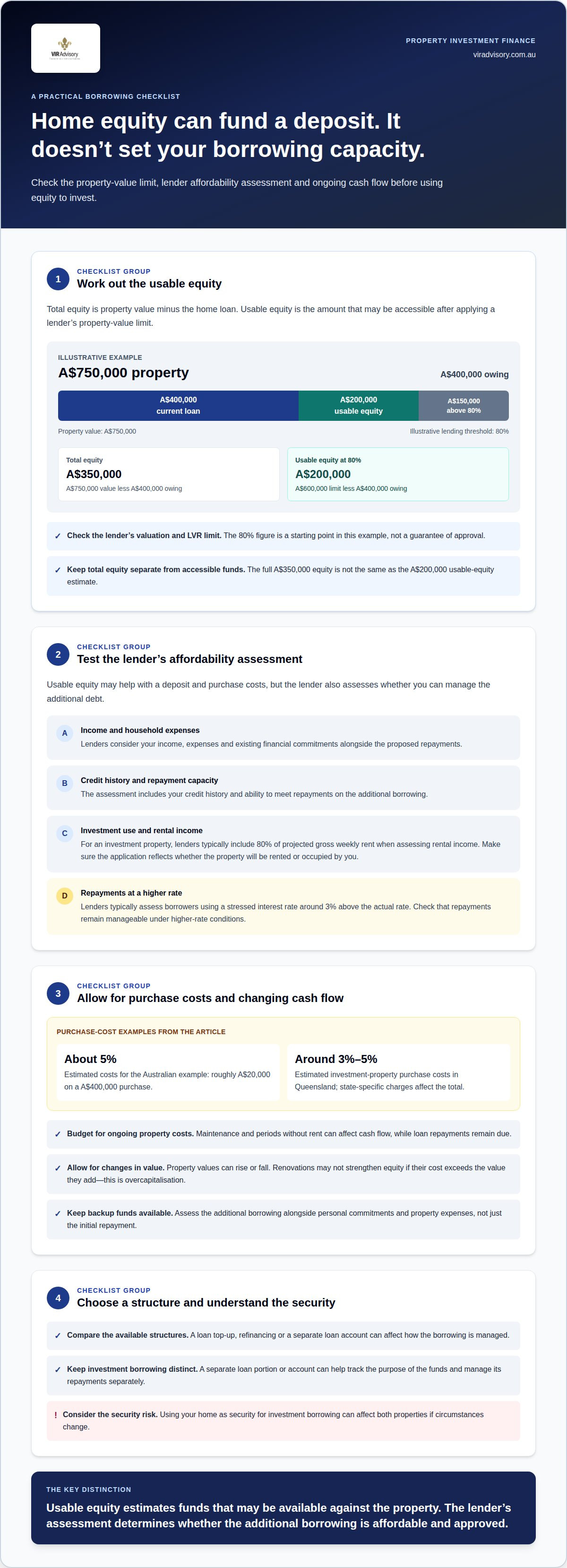
For example, a home valued at A$750,000 with A$400,000 owing has A$350,000 in total equity. At an 80% lending threshold, the maximum debt against that value would be A$600,000. Subtracting the existing A$400,000 loan leaves A$200,000 in usable equity in this example.
Usable equity is not the same as the full amount of equity you own. A broker can estimate how much may be accessible by reviewing the property value, loan balance and lender’s loan-to-value ratio (LVR) limit. The lender then assesses your application and ability to afford the additional repayments.
Investment borrowing versus second-home borrowing
Investment borrowing is for a property intended to earn rental income, while second-home borrowing is for a property you plan to live in. The distinction matters because lenders assess the intended use and may consider rental income for an investment property.
For example, lenders typically include 80% of projected gross weekly rent when assessing rental income. That figure can affect how the investment loan fits with your existing home loan, income and other commitments. A second home may not have rental income included on the same basis, so the application should reflect its actual purpose.
Be clear about whether you plan to rent out the property or live in it. The intended use informs the finance assessment, while the property’s value and your financial position affect how much you may be able to borrow.
Accessing and separating equity borrowing
A broker assesses access to equity by reviewing your current loan, estimating the property value, calculating the LVR and examining your income, expenses and commitments. They can then compare finance structures and estimate how much you may be able to borrow for the purchase.
For example, with A$200,000 in usable equity, the broker can assess how that amount might contribute towards a deposit and purchase costs, alongside a separate investment loan. The equity figure alone doesn’t set the purchase price: the lender also assesses repayments and overall borrowing capacity.
You can ask for the amount added to your home loan to sit in a separate loan portion or account. This helps distinguish investment borrowing from your original home loan and allows the additional portion to be repaid separately. Keeping the funds separate also makes their use easier to track.
Building equity through repayments and property value growth
Equity can grow as you repay loan principal or as your property’s market value rises. For an investor, this may create borrowing options, but repayments and ongoing costs still need to fit your household cash flow.
Regular repayments reduce your loan balance over time. Extra repayments can speed up that reduction if your loan allows them, while savings in an offset account can reduce interest and help more of each repayment go towards principal.
Property value growth can also increase equity, although market values can fall as well as rise. Renovations may add value when the improvements suit the property and its market. If the cost of renovations exceeds the value they add, this is overcapitalisation, and the work may not strengthen your equity as intended.
Equity used for a non-investment purchase is still borrowing that must be repaid. Keeping that amount in a separate loan portion can help you track its purpose and repayment progress. For example, if you use equity for a personal purchase, those repayments still need to come from your cash flow.
Affordability needs to account for changing interest rates, not just the initial repayment. Lenders typically assess borrowers using a stressed interest rate around 3% above the actual rate.
Investment-property repayments sit alongside costs such as maintenance and periods without rent. Purchase costs also need to be budgeted: the Australian example estimates costs at about 5% of the property price, or roughly A$20,000 for a A$400,000 purchase. In Queensland, estimated investment-property purchase costs are around 3% to 5% of the purchase price, with state-specific charges affecting the total.
Before increasing your borrowing or refinancing, assess repayments under higher-rate conditions and allow for property expenses and personal commitments. This helps distinguish equity growth on paper from borrowing you can comfortably manage.
Potential benefits and risks of using equity
Equity can provide investment funds without selling your home, but it also increases debt secured against property. When buying an investment, the difference between accessible funds and affordable borrowing is important.
Investment risks and tax implications
Borrowing against home equity can provide access to funds, generally at home-loan interest rates that are lower than those for other credit. The investment still needs to perform financially: if rental income falls or expenses rise, interest and repayments remain due.
Tax treatment depends on how borrowed funds are used and your individual circumstances. Australian investors with a negatively geared property may be able to claim some investment outlays and a portion of loan interest as deductions. The purpose and use of each loan portion matter, so keep investment borrowing separate from personal spending.
For example, borrowing against your home to fund an investment links your home to that investment debt. Cross-collateralisation involves two loans: the original mortgage secured by your existing property, and a new mortgage secured by both properties. This structure can put both assets at risk if repayments become difficult.
A property valuation estimates its value at a specific point, based on factors such as condition, features and construction. It does not remove the risk that market values may change or that the investment’s return may not cover its costs.
Borrowing risks and financial buffers
Using home equity increases your mortgage balance and may increase repayments. If you cannot meet them, both your home and investment property may be at risk. Investment losses also leave interest costs on the borrowed funds, adding to the financial impact.
Keep backup funds rather than committing every dollar of usable equity to the purchase. Allow for periods without rental income, such as time between tenants, as well as repairs and other property expenses. A vacancy can strain cash flow even if the property is rented for most of the year.
Compare the borrowing commitment with your long-term goals, including existing home repayments and planned expenses. A short-term investment can be risky, while long-term property investment may suit some investors. Neither approach removes market or repayment risk.
A lending specialist can model repayments and cash flow across different borrowing amounts, including periods without rent. This helps show whether the purchase fits your budget and wider plans, rather than relying on a valuation or projected rent alone.
Loan-to-value limits and Lenders Mortgage Insurance
A lender’s loan-to-value ratio (LVR) compares the loan amount with the property’s assessed value. When you access equity, the lender’s LVR limit affects how much additional borrowing the property can support. Lenders Mortgage Insurance (LMI) may apply at higher LVRs.
For example, a home valued at A$800,000 with A$480,000 owing has total equity of A$320,000. At an 80% LVR, total lending against that value would be A$640,000, leaving A$160,000 before considering affordability and lender requirements. A bank valuation may differ from an owner’s estimate, changing the equity calculation.
Borrowing above 80% of a home’s value may require LMI, and a 20% deposit is generally needed to avoid it on an Australian investment property. Some lenders allow investment purchases at 90% LVR with LMI. The premium adds to the finance required, so compare its cost and effect on repayments against using a larger deposit or buying at a lower price.
A loan top-up increases borrowing with the existing lender and may suit a borrower seeking access to equity without replacing the whole mortgage. Refinancing replaces the current loan with a new one, which can change the structure or lender, but requires assessment of the full application. A top-up can typically provide funds within two to three weeks. Bridging finance may address a timing gap between buying and selling, but adds another repayment commitment to assess.
A separate supplementary loan account can keep investment borrowing distinct from your home loan. This helps you track the purpose of funds and manage repayments separately, especially if you also use equity for renovations or personal spending. Keeping uses separate supports clearer records, while combining different purposes can make loan tracking more difficult.
Choose a loan based on your purchase plan, cash flow and repayment capacity, not just the capital available. A lender assesses your income, expenses, commitments and credit history alongside the property’s value. For example, you may have enough equity for a deposit but still need a loan structure with repayments that fit your finances. Comparing a top-up, refinance and separate account helps show how each option affects your debt, security and repayment management.
Lending limits based on property value
A lender’s property-value limit sets one boundary, not the final borrowing amount. In Australia, banks are generally comfortable lending up to 80% of a home’s value when calculating usable equity. The lender uses its accepted market value, which may come from a formal bank valuation, rather than the owner’s estimate. The calculation applies the LVR limit to that value, then subtracts existing debt.
At 80% of its value, lending would reach A$320,000, leaving A$100,000 in usable equity after subtracting the existing loan. This illustrates why the property’s market value and current mortgage balance both affect the estimate.
A rule-of-four guide estimates a target purchase price by multiplying usable equity by four. So A$100,000 in usable equity may indicate a property price around A$400,000. However, a purchase also involves costs such as stamp duty. In the A$400,000 example, an A$80,000 deposit and roughly A$20,000 in purchase costs together use the A$100,000. Stamp duty and other costs differ by state and transaction.
That estimate addresses the property-value side, not whether you can afford the lending. Australian lenders assess income, employment status, savings, financial commitments, living expenses and credit history. For an investor, proposed loan repayments must also fit alongside existing debt and household expenses. Even with sufficient equity, your borrowing limit may be lower if income or commitments restrict your repayment capacity.
Treat usable equity as a starting figure, then account for purchase costs and borrowing capacity. A lender or mortgage broker may require a formal valuation to establish the property value used in the calculation. Applications are subject to credit approval, and the lender assesses both the property security and your circumstances. A purchase price suggested by a rule-of-four estimate is not the same as an approved loan amount.
VIR Advisory
Before using home equity to buy an investment property, check both the lender’s property assessment and whether your income can support the additional repayments. Usable equity is only one factor: the borrowing limit also depends on existing debts, income, expenses and how the additional debt is secured. A lender’s valuation may also differ from your estimate, so equity available on paper does not necessarily equal a purchase budget that fits your finances.
Before making an offer, compare a loan top-up with refinancing or a separate loan account. Review your existing home loan, planned investment borrowing and the lender requirements relevant to your circumstances. Consider the repayment obligations and loan structure before your purchase timetable or property choice is fixed.
To prepare for a lender assessment, gather details of your current loans, income, regular expenses, financial commitments and intended purchase. If you are self-employed or a company director, how your income is documented can affect the lender’s assessment. Check that proposed repayments work alongside your existing obligations rather than relying on the property’s value alone.
Finance assessment checklist: confirm your usable equity, obtain a lender valuation, document income and expenses, compare loan structures, and test repayments against your cash flow. Account for the possibility that the lender approves less than you expect or that the valuation is lower than anticipated.
VIR Advisory specialises in home loans, refinancing, commercial finance, business lending and property investment finance. Its Home Loans and Investment Property Loans relate to residential borrowing, while Refinancing solutions may be relevant when reviewing an existing loan structure. Financial strategy guidance can help you consider how new debt fits with cash flow and longer-term plans. Where business commitments affect affordability, Business Loans may be relevant to the broader lending picture. The appropriate option depends on the borrowing purpose and your financial position.
Contact VIR Advisory to discuss your investment property finance options.
Frequently Asked Questions
What’s the difference between equity and usable equity?
Equity describes your financial stake in the property; usable equity is the amount a lender may allow you to borrow. The distinction matters when setting a purchase budget, because the lender’s valuation and lending criteria determine the accessible amount. A valuation may differ from your estimate, so avoid basing an offer solely on an online property estimate or the original purchase price.
How much can you borrow?
The approved amount depends on the lender’s assessment of your security and ability to repay. When using equity to buy an investment property, consider total lending across your home and investment loans, rather than focusing only on the deposit. Existing debts, income, expenses and the proposed loan structure all influence the assessment. Your purchase budget should also account for costs beyond the property price.
How much deposit do I need for my new property?
The deposit depends on the purchase price, lender requirements and funds available to you. It may come from savings, accessible equity or a combination of both. Plan for the deposit separately from other purchase costs: using all available funds for the deposit can leave less cash for expenses after settlement. The lender assesses the proposed funding arrangement as part of your application.
What is equity and how do you calculate equity?
Equity is the difference between a property’s current market value and the amount secured against it. For a useful estimate, use a current valuation and the latest loan balance, rather than the original purchase price. The result can change as you repay the loan or market values move. The lender uses its own valuation for the assessment, which may not match your expectations.
What is equity and usable equity?
Usable equity is the portion of a property’s equity that a lender may accept as security for further borrowing. It is assessed using the lender’s valuation and criteria, so the amount can differ between lenders. Distinguish this potential borrowing from cash you already have: accessing it requires a lending application and approval based on your circumstances.
How does using home equity to buy an investment property work in Australia?
You apply to release funds against your existing home and use the approved amount towards an investment purchase. Using equity to buy an investment property means coordinating that borrowing with the loan for the new property. The lender reviews the security and your overall finances. Keeping a clear record of how you use the released funds helps distinguish investment-related borrowing from personal spending.
What deposit and upfront costs are needed to buy an investment property in Australia?
Plan for a deposit and separate funds for transaction costs, including state-based stamp duty. The exact duty depends on the property and relevant state or territory, so it varies across Australian purchases. Include these costs in the total funds required rather than treating the deposit as the complete upfront amount. The lender’s assessment also considers the proposed borrowing and property purchase details.
Can I use a home equity loan, line of credit or cash-out refinance to invest in property?
Each structure can provide access to funds, but loan terms and repayment arrangements differ. A home equity loan creates borrowing secured by property; a line of credit provides access to a credit limit; and cash-out refinancing restructures existing lending to release funds. Using equity to buy an investment property through any of these options adds debt and can put your home at risk if you do not maintain repayments.

Article by
Raina Doshi
Raina Doshi has worked in banking and finance since 2011, including experience with major Australian lenders. She helps homeowners, property investors, business owners and professionals secure and structure lending solutions across home loans, refinancing, commercial finance and business lending.
Areas of expertise include residential lending, investment property finance, debt recycling, commercial property finance, equipment finance, construction finance and strategic debt structuring.
Drawing on extensive banking and finance experience, Raina helps clients navigate lender requirements, improve borrowing outcomes and structure effective finance solutions.
Disclaimer
The information in this article is general in nature and does not take into account your personal objectives, financial situation or needs. Before acting on any information, consider whether it is appropriate to your circumstances and seek professional advice.


