

A bank isn’t automatically the simpler or cheaper choice, and a broker doesn’t automatically have access to every lender. In the mortgage broker vs bank comparison, the key difference is choice: a bank discusses its own home loans, while a broker can compare options from lenders on an approved panel. The right fit depends on your borrowing circumstances, the loan features you need and the options available through each channel.
It’s reasonable to focus on the interest rate, but the loan structure, fees and approval requirements also affect whether it fits. Brokers are generally paid commissions by lenders and must disclose them; some may also charge borrowers a fee. A bank’s lending staff discuss that bank’s products rather than comparing loans across the market.
This article explains how banks and brokers differ in loan choice and commissions, when a bank’s direct offer may suit a straightforward application, and how a broker’s lender-panel knowledge can help with self-employed income, complex finances or investment borrowing. It also provides a practical framework for deciding which option to explore first.
Key Takeaways
- A bank can explain its own home loans; a broker can compare options across an approved lender panel, which may not cover every lender.
- Choose your borrowing channel by weighing loan features, lender requirements and your circumstances, not the interest rate alone.
- Irregular income, self-employment or a complex application can make lender policy a key part of the decision.
- Understand how a broker is paid: lender commissions are generally disclosed, and some brokers may also charge borrowers a fee.
- Use the article’s decision guide to identify when a direct bank application may suit and when a broader lender comparison could help.
Can a broker choose one loan automatically?
No. In Australia, a mortgage broker can compare home loans and recommend an option, but can’t automatically choose or commit you to one. A bank can discuss its own lending products, so a direct application compares one lender. The decision remains yours after you’ve considered the loan features, costs and approval requirements.
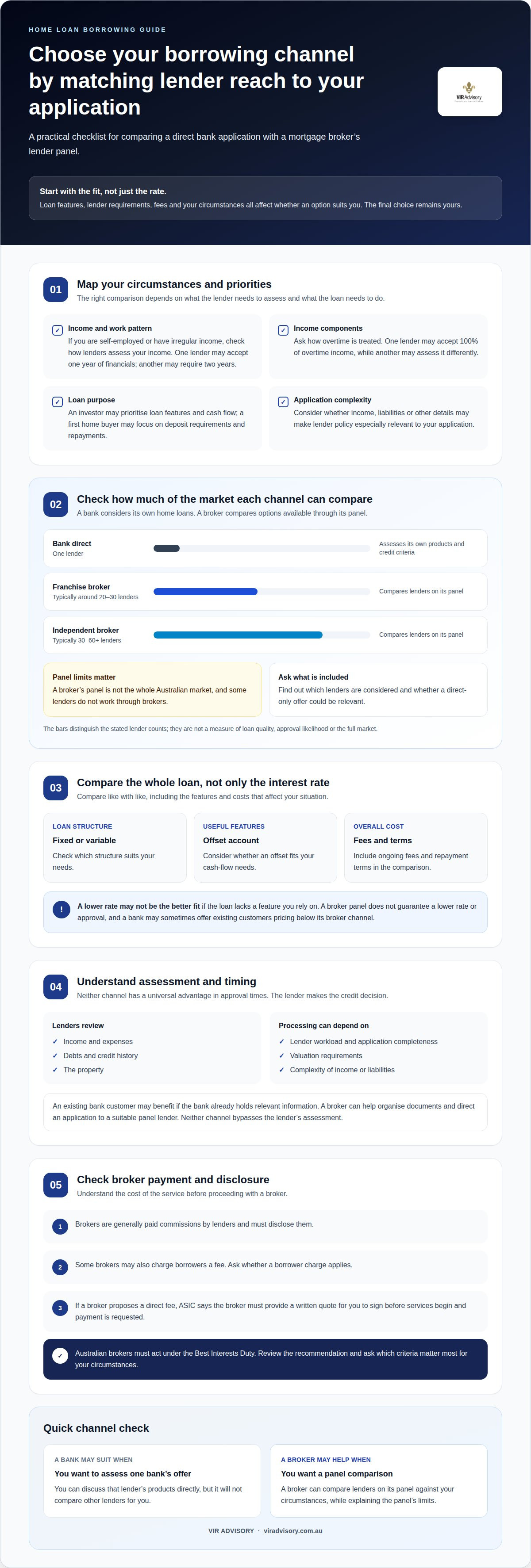
An independent broker may have access to 30-60+ lenders, while franchise mortgage brokers typically compare around 20-30 lenders. These are different lender panels, not the whole Australian market, and some lenders don’t work through brokers. Ask which lenders are included in the comparison and whether a direct-only offer could be relevant.
A bank applies its own credit policy to your application. Lenders may assess income, debts, deposit and property differently, so a home loan that fits one bank’s criteria may not fit another’s. A broker can compare lenders on their panel against your circumstances, but the panel still has limits.
| Option | Loan choice | Policy and comparison | Negotiation |
|---|---|---|---|
| Independent broker | Typically 30-60+ lenders | Compares lenders on its panel | May negotiate with a current lender or seek another lender’s offer |
| Franchise broker | Typically around 20-30 lenders | Compares lenders on its panel | Can approach panel lenders, subject to their policies |
| Bank direct | One lender | Assesses its own home-loan products and credit criteria | Can discuss its own offer, not compare other lenders for you |
Compare more than the headline interest rate. Check whether a fixed or variable loan suits you, whether an offset account fits your cash-flow needs, and how ongoing fees affect the overall cost. For example, a lower rate may not suit you if the loan lacks a feature you rely on. Compare like with like, including repayment terms and fees.
A broker’s panel can provide options, but it doesn’t guarantee a lower rate or approval. Brokers may negotiate with your current lender or approach another lender after your loan contract is signed. A broker may also review existing loans for repricing, while your bank may sometimes offer existing customers pricing below its broker channel.
Australian brokers must act under the Best Interests Duty. If a broker proposes a direct fee, the Australian Securities and Investments Commission says the broker must provide a written quote for you to sign before services begin and payment is requested. Choose a channel by matching its lender access and loan terms to your needs, then review the recommendation before proceeding.
Mortgage Broker vs Bank: What's Better for You?
The better option depends on your income, loan purpose and the lender’s criteria. Compare the process, eligibility and loan fit, not just the advertised interest rate.
Broker Access to Multiple Lenders
In Australia, a mortgage broker assesses your circumstances, identifies relevant lenders on an approved panel and helps prepare an application. Brokers may compare home loans from 20 or more lenders, although each panel has limits. Their role is to match your profile and goals with lenders whose policies may suit, then explain the available options.
For example, an investor may prioritise loan features and cash flow, while a first home buyer may focus on deposit requirements and repayments. A broker can compare these criteria across panel lenders, but not every lender in Australia.
Bank Products and Lending Requirements
A bank assesses applications against its own products and credit policies. This may suit borrowers who already bank there and want to discuss that lender’s features, but it won’t provide comparisons with other lenders. An approved broker panel offers broader choice, though its lenders and products also have boundaries.
Eligibility can vary by policy. One lender may accept 100% of overtime income, while another may assess it differently. That distinction can change how an applicant’s income supports borrowing capacity, even when the interest rate appears competitive.
Approval Times and Eligibility
Neither channel has a universal advantage in approval times. A lender’s workload, application completeness, valuation requirements and the complexity of your income or liabilities can affect processing. An existing bank customer may benefit if the bank already holds relevant information, while a broker can help organise documents and direct an application to a suitable panel lender.
Eligibility still depends on the selected lender’s criteria. Some lenders may consider a self-employed applicant with one year of financials; others may require two years. A broker can identify differences in lender policies, but neither channel bypasses the lender’s assessment.
Applying Through a Broker or Bank
Applying through a broker means discussing your goals and finances, then considering suitable options from the broker’s panel. Applying directly means giving your information to one bank and assessing its home-loan offer. In both cases, the lender reviews income, expenses, debts, credit history and the property before deciding.
A mortgage broker in Australia can assess your profile, compare panel options, explain loan features and coordinate your application with the chosen lender. Before choosing, ask which lenders are considered, how the broker is paid, whether a borrower charge applies and which criteria matter most for your circumstances.
Choosing a borrowing channel for complex circumstances
For complex borrowing, compare how each channel handles your income, liabilities and loan purpose. A broker can assess options across an approved lender panel; a bank applies its own criteria. Neither channel changes the information lenders need to review serviceability, credit history and the proposed security.
Consider a sole trader earning A$260,000 annually, with A$110,000 in student debt and considering a A$1.1 million home loan. Income alone doesn’t show how a lender will assess the application. Business financials, income evidence, existing commitments and the lender’s treatment of debts all affect borrowing capacity. A broker experienced with self-employed applications can identify relevant panel policies; a direct application tests one bank’s approach.
Relevant experience means understanding how lenders assess variable income, company-director earnings, existing property debt or credit issues, then explaining which documents support the application. Ask how the broker has handled similar borrower profiles and how the proposed lender assesses your income. An independent broker can compare lenders on its panel, but that access doesn’t cover every lender.
Remuneration also matters. Australian mortgage brokers generally receive lender-paid commission, usually an upfront commission and an ongoing trail commission, both calculated as percentages of the loan amount. Market figures place upfront commission around 0.5-0.7% and trail commission around 0.15-0.2% annually. Brokers must provide borrowers with information about commissions they may receive. The Best Interests Duty requires brokers to prioritise borrowers’ needs when providing credit assistance.
Some brokers may also charge an upfront fee, a success fee or both. If a broker proposes a direct fee, the Australian Securities and Investments Commission says a written quote must be provided and signed before services begin and payment is requested. Clarify whether you’ll pay a fee, what triggers it and how lender commissions are disclosed. This distinguishes the broker’s remuneration from the lender’s interest rate and loan costs.
Use these steps to assess whether a broker’s experience and costs suit your circumstances:
- Summarise your income sources, debts and loan purpose.
- Ask which lender policies and panel options are relevant.
- Request a clear explanation of commissions and any borrower fee.
- Compare the recommended structure, rate and costs against your priorities.
A direct bank application may suit borrowers whose finances align with that bank’s criteria and who prefer dealing with one lender. A broker may help when income sources, debt structures or credit history make lender policy central to the decision. Weigh relevant experience, lender access and remuneration rather than assuming either channel is automatically more suitable.
Upfront and trailing broker commissions
In Australia, lenders generally pay mortgage brokers a commission for arranging home loans, rather than borrowers paying directly. The usual structure includes an upfront commission and an ongoing trail commission, both calculated as a percentage of the loan amount. This explains how a broker may be paid, but doesn’t show whether a particular loan suits your circumstances.
Market figures put upfront commission at around 0.5-0.7% of the loan amount. Trail commission is usually around 0.15-0.2% annually. The upfront component relates to arranging the loan; the trail is an ongoing commission. Lenders pay both, and the broker must disclose commissions borrowers may receive information about.
For borrowers, the practical distinction is between lender-paid commission and a direct charge. Brokers generally don’t charge customers for standard home loans, but some may charge an upfront fee, a success fee or both. A fee charged directly to a borrower is separate from a lender’s commission, so ask which applies to your application.
Franchise arrangements can also affect how commission is distributed. Franchise brokers may split 20-30% of commission with a parent network or head office. That figure describes a potential split within the business arrangement, not an additional fee automatically charged to the borrower. It also doesn’t establish the quality or suitability of a recommended loan.
Commission creates a potential conflict worth understanding: the broker is paid by a lender whose product is being arranged. Australian mortgage brokers must act under the Best Interests Duty, and commissions must be disclosed. Consider the recommendation alongside the loan’s interest rate, features, fees and fit with your needs, rather than treating commission alone as proof of bias or independence.
Before proceeding, ask for a clear explanation of how payment works in your case:
- Will a lender pay upfront and trail commission, and how are those amounts disclosed?
- Will you pay a direct fee, and is it upfront, success-based or both?
- Does a franchise or network share part of the broker’s commission?
- How does the recommended home loan suit your requirements, beyond its commission?
If a broker proposes a direct fee, the Australian Securities and Investments Commission says the broker must provide a written quote. You must sign it before the broker provides services and requests payment. This gives you a documented basis for understanding the charge before the work begins.
Compare the loan’s total costs and structure, not simply whether a broker charges you directly. A direct bank application avoids broker commission, while a broker-arranged loan is generally paid for by the lender. Either way, the interest rate, loan features and lender criteria remain central to assessing value.
Australian mortgage broker and bank market share
Mortgage brokers held 81.0% of the Australian mortgage market in March 2026, compared with 55.3% in March 2018. That represents a rise of 25.7 percentage points over eight years. The figures indicate how commonly borrowers use brokers, but market share alone doesn’t establish whether a broker or bank suits a particular application.
A separate measure tracks new residential lending. Brokers settled 76.0% of new Australian residential home loans in the December 2024 quarter, valued at A$115.06 billion. These figures cover different periods and measures, so they shouldn’t be treated as interchangeable. They show that brokers are a significant channel alongside direct bank applications, not that one route delivers better outcomes for every borrower.
Assess the application rather than following the market majority. A first home buyer may need to compare deposit requirements and borrowing capacity, while an existing owner refinancing may focus on loan features, switching costs and lender criteria. Market share won’t tell you which lender will assess your income or property most appropriately.
Market figures also don’t show which lenders are available for an individual application. A broker’s options depend on its approved panel, while some lenders accept applications directly only. Some banks can process home-loan applications for property purchases across Australian states. The relevant question is whether the channel can access lenders and assessment policies suited to your borrowing purpose.
Australian mortgage brokers operate under ASIC oversight and need to hold an Australian Credit Licence; listed finance and mortgage broking qualifications are usually required. Brokers have been legally required to act in borrowers’ best interests since January 2021. The Best Interests Duty requires a broker to prioritise the borrower’s needs when providing credit assistance, rather than simply selecting a loan automatically.
Use market share as context, then assess the details that affect your application:
- For a purchase: compare deposit requirements, lender criteria and available loan features.
- For refinancing: weigh the proposed structure and features against switching costs and your current loan.
- For complex income: consider whether the relevant channel can access lenders with suitable assessment policies.
The increase from 55.3% in March 2018 to 81.0% in March 2026 shows that broker-arranged lending has become a common choice in Australia. It doesn’t make a broker the default answer. Use the figures to understand the market, then base your decision on the lenders, criteria and loan structure relevant to your circumstances.
VIR Advisory: Mortgage Broking
Mortgage broking can help borrowers compare lender options, structure a home loan or review refinancing. It may be useful when self-employed income, existing debts or an investment property make lender requirements central to the decision. The comparison can focus on borrowing capacity, loan features, costs and how each lender assesses your circumstances.
A direct application may suit you if a bank’s products and criteria match your needs. Mortgage broking offers a way to consider options across an approved lender panel, while the lending decision remains yours.
VIR Advisory is a mortgage and finance brokerage. Contact VIR Advisory to discuss your borrowing requirements.
Set your next lending decision up clearly
Before submitting an application, connect your borrowing decision to your next plans. Note whether you’re purchasing, refinancing or arranging business finance, and identify any upcoming changes to income, debts or property commitments. This keeps the lending discussion focused on the purpose and structure you need, rather than treating an advertised rate as the whole decision.
The mortgage broker-versus-bank choice can also shape how you approach future borrowing. For example, an investment purchase may sit alongside a home loan or business finance, so the structure of one facility can affect your wider funding picture. Consider the immediate application in that broader context, including cash flow and the flexibility you may need.
VIR Advisory offers Home Loans, Business Loans and Refinancing solutions. Its mortgage broking service can help assess lending options against your borrowing purpose and circumstances, whether you’re buying a home, reviewing an existing loan or arranging business finance.
A well-prepared discussion gives you a clearer basis for deciding what to do next.
Frequently Asked Questions
Lender Panel Access: Who Compares What for You?
A broker compares eligible options from lenders on its panel, while a bank discusses its own products. The key question is whether the available range covers the features and assessment policies your application needs. For example, compare repayment flexibility, offset access, fixed-rate options and how lenders assess income, then note which options meet your requirements. Panel access isn’t the same as access to every lender in Australia.
Borrower Scenarios: Which Route Works When?
The route depends on the application, not the location. For example, a first-home-buyer couple with A$160K combined income, a A$120K deposit and a planned A$1.1M apartment purchase could compare a bank’s deposit and servicing requirements with options available through a broker’s panel. The key decision is which lender criteria best fit their deposit, expenses and borrowing capacity, not whether one channel suits every buyer.
What about cost?
Compare the loan’s full cost, not just whether a broker charges you directly. Consider the interest rate, ongoing account fees, application or valuation charges, and any features you’ll actually use. A direct bank application may avoid a broker fee, while a lender may pay the broker. Ask for a clear breakdown so you can compare the same loan structure and features across options.
What about interest rates?
Neither channel guarantees a lower interest rate. A bank may have direct-only discounts or offers, while a broker can compare rates across lenders on its panel. Compare equivalent loan structures and consider fees, repayment features and eligibility alongside the advertised rate. If you already have a loan, compare its cost and features with a proposed alternative, including any switching costs.
What are the pros and cons of each?
A broker can save you from approaching lenders one by one and may identify different policy approaches for a particular income or loan purpose. The trade-off is that the comparison covers the broker’s panel, not every lender. A bank provides direct access to its own products and may suit someone familiar with its services, but the direct process won’t compare competing lenders on your behalf.
What are the pros of going directly to a bank?
Going direct may suit borrowers who know which bank and loan features they want, or who qualify for an offer available only through that bank’s own channel. An existing customer may also find the application more straightforward if the bank already holds relevant information. The limitation is scope: bank staff can explain their products, but a direct application doesn’t assess other lenders’ alternatives.
What happens when you go straight to a bank?
You provide the bank with details of your income, expenses, debts, deposit and property plans. The bank assesses those details against its lending criteria and the loan you’ve applied for. It may request further documents or information before making a decision. Ask the bank to explain how it assessed your income and commitments, and which loan features or conditions apply to its offer.
Do Australian mortgage brokers charge borrowers fees, and how are they paid?
Review the broker’s credit guide and disclosure documents before authorising work, then clarify the payment conditions for your application. Ask whether any borrower-paid amount is due upfront, on settlement or if the loan doesn’t proceed. Also confirm what work the arrangement covers and whether the lender’s payment could change if the loan amount or structure changes. These details help you understand the terms before proceeding.

Article by
Raina Doshi
Raina Doshi has worked in banking and finance since 2011, including experience with major Australian lenders. She helps homeowners, property investors, business owners and professionals secure and structure lending solutions across home loans, refinancing, commercial finance and business lending.
Areas of expertise include residential lending, investment property finance, debt recycling, commercial property finance, equipment finance, construction finance and strategic debt structuring.
Drawing on extensive banking and finance experience, Raina helps clients navigate lender requirements, improve borrowing outcomes and structure effective finance solutions.
Disclaimer
The information in this article is general in nature and does not take into account your personal objectives, financial situation or needs. Before acting on any information, consider whether it is appropriate to your circumstances and seek professional advice.


